
Lean In’s New Report Forgot Women Are Mothers. I Am Not Joking.
They blamed women for lacking ambition, their own data blames the workplace

I spent the entire day reading the 2025 Women in the Workplace report cover to cover. This is the biggest study on women in corporate America. It is supposed to diagnose the problem accurately and tell us what women need. And do you know how many times they mention care, caregiving, parenting, childcare, or eldercare?
Zero. Not once.
Not in the analysis.
Not in the recommendations.
Not even in the footnotes.
For an organization with “women” in its name, this omission is astonishing.
Actually, no, it’s revealing.
Because when you erase care, you create the illusion of an “ambition gap.”
When you erase caregiving, the invisible labor overwhelmingly done by women, you can comfortably say, “Women just don’t want to be promoted as much as men.”
When you erase motherhood and the universal reality of family responsibilities, you can frame women’s choices as personal failures instead of institutional design failures.
And guess what?
That’s exactly what this report does.
The Report Claims Women Want Promotion Less. Their Own Data Says the Opposite.
Lean In declares an “ambition gap”: women “want promotions less” than men.
But here’s what the charts actually show:
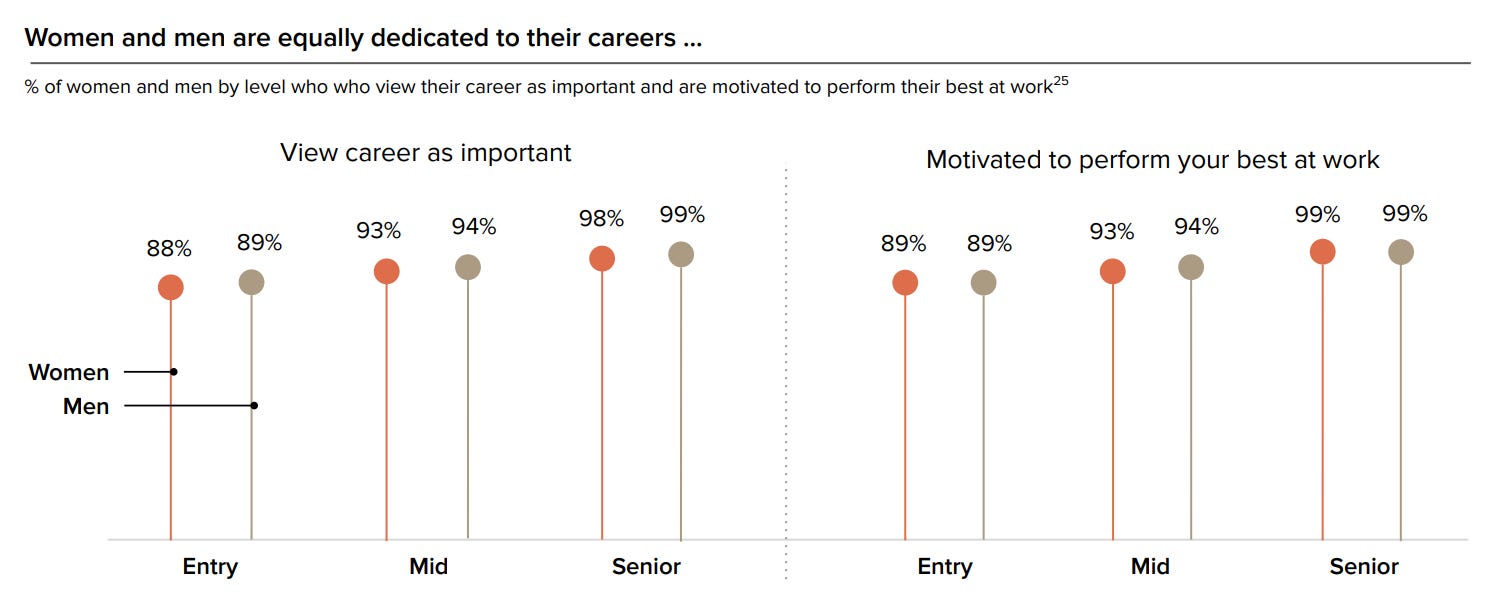
Women and men are equally motivated and equally committed to their careers, around 90–99% on every measure.
Young women (under 30) are more ambitious than their male peers.
Latinas are the most ambitious group in the entire dataset, with ~90% wanting promotion.
And this is the kicker: when women receive the same career support as men, the ambition gap completely disappears.
Their own report says this in black and white.
The problem is not ambition.
The problem is the absence of support, sponsorship, flexibility, and structural fairness.
The problem is a workplace built on male norms, where a “committed worker” is someone with zero caregiving responsibilities and a wife at home.
The problem is the Care Gap.
What Women Actually Have Is a Care Gap — And Lean In Doesn’t Mention It Once
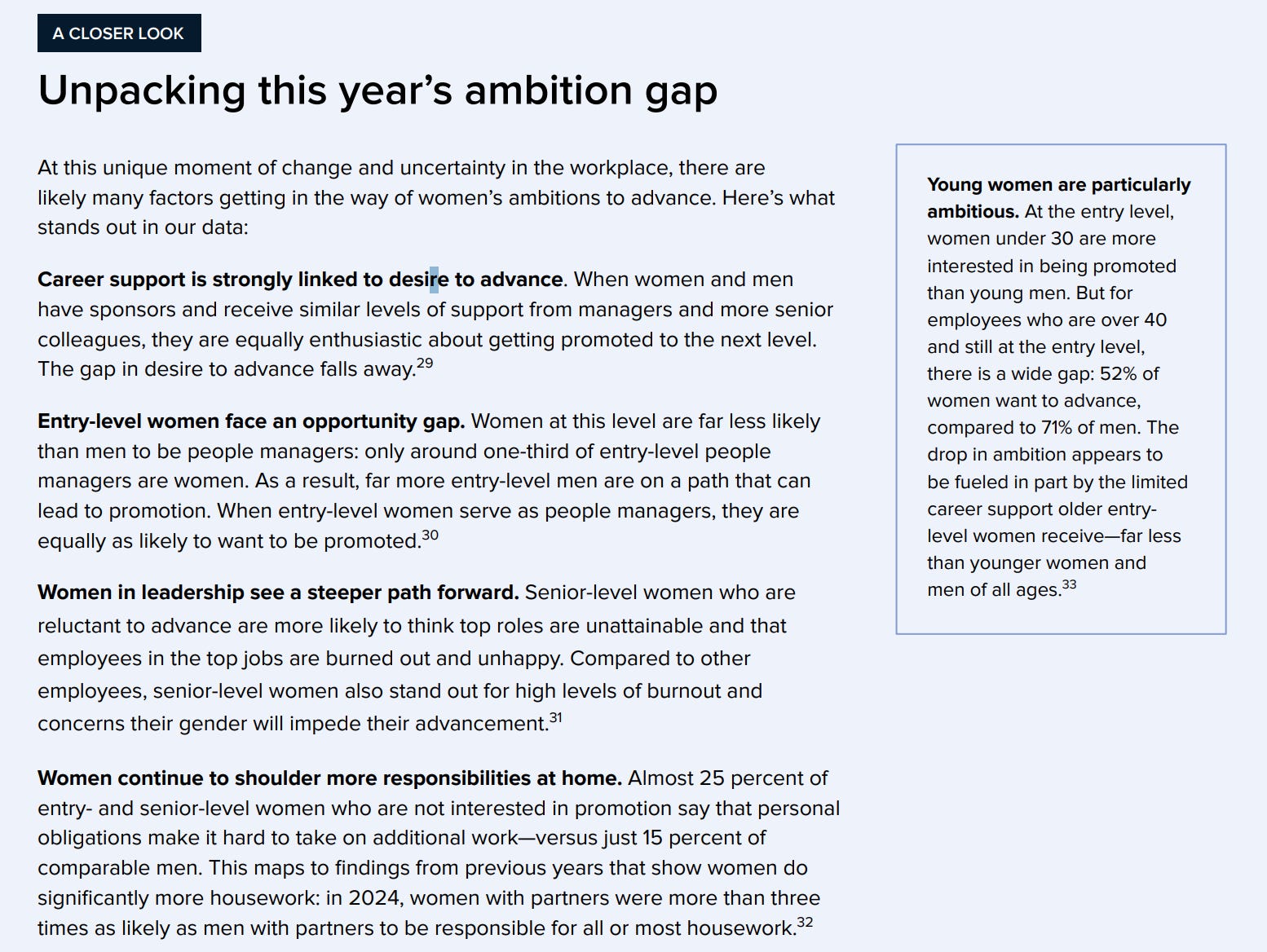
On page 10, tucked inside a small box, the report briefly acknowledges that women who say they don’t want a promotion cite “personal obligations” at much higher rates than men.
Then it immediately moves on.
No analysis.
No context.
No mention that “personal obligations” is code for:
Childcare
Elder care
Household management
Emotional and cognitive labor
School schedules
Medical appointments
The default parent role
The unpaid 2nd shift
You know, the entire invisible care infrastructure that women manage so corporations don’t have to.
Lean In analyzed the gender gap in promotion desire without once asking: Who is doing the care? Who is carrying the load? Who is propping up the whole economy at home?
This is not a small oversight.
This is the core issue.
And they left it out entirely.
When Care Is Ignored, Women Get Blamed. That’s What This Report Does.
The report’s framing is the classic pattern:
Women are burned out → women lack ambition.
Women hesitate to pursue promotion → women lack confidence.
Women decline advancement in a system built to punish them → women “opt out.”
This is the same tired narrative we hear everywhere:
Men’s choices are structural. Women’s choices are personal.
But if you put care and caregiving back into the analysis, the story shifts dramatically:
Women aren’t avoiding promotion, they’re avoiding overwork with no support.
Women aren’t lacking ambition, they’re lacking childcare, predictable hours, and inclusive management.
Women aren’t opting out, workplaces are pushing them out through rigidity, bias, and deliberate defunding of DEI and caregiver supports.
The data even shows this explicitly:
1. Women get less sponsorship.
Especially entry-level women, Asian women, and senior-level women.
2. Women get fewer stretch opportunities.
This is literally how careers accelerate. Men get more of them.
3. Women are punished for remote or flexible work.
Men are not. Women who work remotely are less likely to be sponsored, seen, or promoted, but formal flexibility has been cut back across organizations.
4. Senior women are burning out at the highest rates in five years.
Especially Black women, who report both high burnout and low security.
5. Companies are quietly deprioritizing women.
Here’s the part that should make every woman furious. Only half consider women’s advancement a business priority. A shocking 20% admit it’s not a priority at all. But somehow the takeaway is that women need to “want promotion more.” Again, wow.
The Workplace Is Still Built Around Male Norms
Lean In keeps measuring women against a leadership model built for someone who:
Has no caregiving responsibilities
Has a spouse handling domestic logistics
Can be in the office at all hours
Can travel last minute
Does not carry the emotional or mental load of a household
Has a body that will never be pregnant
That’s not neutrality.
That’s a male-default system.
If you don’t redesign the system, you can survey women all day long and still conclude, “Women just aren’t as ambitious.”
Women have changed. The workforce has not.
Women Made Historic Gains. That’s Exactly Why We’re Seeing Backlash.
This part is missing from the report but crucial: Women have made massive advancements in education, employment, managerial representation, and economic independence over the last 30 years.
And historically, every time women gain ground, backlash follows.
We are currently living through:
DEI rollbacks
Anti-care policies
Attacks on reproductive freedom
Scaling back flexibility
Retrenchment of corporate diversity commitments
Punishment of remote workers (mostly women)
Re-masculinization of leadership pipelines
The narrative that women have “lost ambition”
It’s not accidental. It’s coordinated cultural and corporate pressure to funnel women back into unpaid care. The workplace “feels” women’s progress — and instead of evolving, it is doubling down on outdated norms.
The Real Story Lean In Missed: Women Are Not Failing. Companies Are.
Here’s what the report should have said:
Women are ambitious.
Women want meaningful careers.
Women are showing up, overqualified and under-supported.
Women are not the problem.
The workplace, still built around male breadwinner assumptions, is the bottleneck.
Companies have begun quietly deprioritizing women’s advancement, and scaling back flexibility.
Without structural redesign, no amount of “leaning in” will create equality.
The gap is not ambition.
The gap is care, sponsorship, visibility, fairness, flexibility, safety, and support.
Everything else is a distraction.
Blessing Adesiyan is the Editor of The Care Gap + Founder & Chief Care Officer at Caring Africa, and a global advisor on care systems, policy, and economy.